28 Apr 2015
Debugging is a fact of life when building apps with Rails or any other set of tools. All troubleshooting is easier when we can see what’s going on inside.
pgcli is a command line tool that lets devs examine PostgreSQL databases from the command line. pgcli offers more powerful features than psql (the default terminal front-end for PostgreSQL) such as:
- Autocompletion. In fact,
pgcli autocompletion is smart enough to only show table names after FROM in a SQL statement.
- Syntax highlighting. Find gotchas quicker, just like you would in a text editor.
Debugging is easier when you can look inside the black box.
Continue reading →
10 Apr 2015
When smart people
challenge each other to grow,
great things happen.
~The ChicagoRuby Motto
If you’re a developer itchin’ to ramp up your Ruby skills, Chicago is a great place to be. The local Ruby user group, ChicagoRuby, continues to expand in time, space, expertise, and numbers. The group is over 3,200 strong, with six events each month plus the annual WindyCityRails conference.
The newest locations on ChicagoRuby’s monthly list are BLUE1647 and 1871.
Continue reading →
31 Mar 2015
The Amazon Dash Button is for customers who crave instant gratification. We might think of Dash as a brilliant blend of the Staples Easy Button, WiFi, and Amazon’s existing database of credit card numbers.

Continue reading →
20 Mar 2015
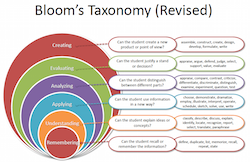
Bloom’s Taxonomy is a framework that breaks the learning process into stages. According to Bloom, learning begins with rote memorization and the process progresses upward until we can apply what we’ve learned in creative new ways.
Youthful Bias
Most of my formal education was science or engineering oriented. I regarded science and engineering as the pinnacle of learning. The extreme position of my youth: All logic fell within math and science, while history, language arts, and other non-science areas were just memorization.
Bloom’s research pushed me beyond my original thinking. Memorization and creativity are vital to all areas of knowledge. Here’s how.
Continue reading →
19 Mar 2015
Users of the Linux or OS X command line know that they can hit the up arrow to view the previously executed command. However, this behavior is missing from the mit-scheme read-evaluate-print-loop (REPL). mit-scheme is the language used in SICP.
For example, hitting the up arrow in the Scheme REPL gives us this non-useful result: ^[[A. The previous command is not repeated.
How do we add up-arrow functionality to the mit-scheme REPL? By using rlwrap.
Continue reading →